What Does Conflict Mean What Is the Conflict in Inside Out and Back Again
Chapter 10: Disharmonize and Negotiations
Later on reading this chapter, you should be able to do the following:
- Understand the unlike types of conflict.
- Empathise the causes of conflict.
- Understand the consequences of conflict.
- Understand how to manage conflict effectively.
- Understand the stages of the negotiation process.
ten.1 Negotiation Failure: The Case of the PointCast
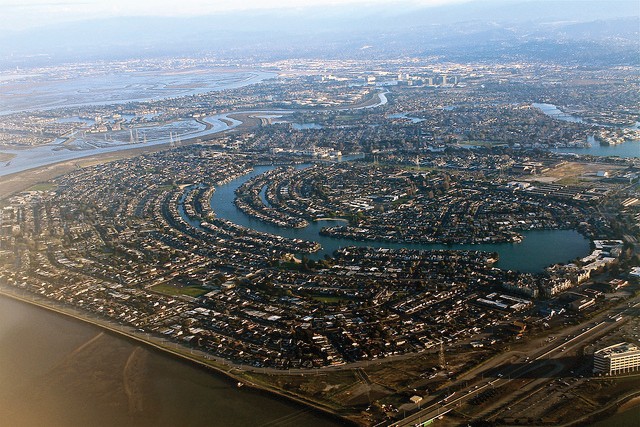
In 1997, a company called PointCast Network Inc. was the hottest offset-upwards in Silicon Valley. Its founder and CEO, Christopher Hassett, was "the most famous guy on the Net," said Hassett's former chaser, Allen Morgan. Hassett was named CNET's newsmaker of the year—an honour previously bestowed on giants such every bit Neb Gates of Microsoft and Larry Ellison of Oracle. The "push technology" that PointCast pioneered was making headlines as well as being featured on the cover of Wired every bit "The Radical Future of the Media across the Web."
All the attending effectually PointCast motivated i of the world's largest communications companies—Rupert Murdoch's News Corporation—to make them an offer of $450 million. Negotiations were intense and lasted weeks. With media speculation that PointCast—a company with most no revenue—deserved to exist valued at $750 meg, some people say Hassett started believing the hype and, with the back up of his board, asked for more than money. "People involved in the company thought they'd be the next Netscape. They hung out for more," Murdoch said. News Corporation instead lowered its initial offer to $400 million only added incentive clauses that brought the offer close to the original $450 million if PointCast met its fiscal projections.
PointCast also rejected that offer, and News Corporation walked away from the bargaining table. The timing couldn't have been worse for PointCast, every bit "push technology" became erstwhile news cheers to the maturing of alternatives such every bit Yahoo! By the time PointCast decided to go public in 1998, the company was valued at half of News Corporation's final offer. Worse, the process of filing an initial public offering (IPO) requires the company to disclose all potential dangers to investors. PointCast's disclosures—such as news that customers had left because of poor functioning—scared off so many investors that PointCast ultimately withdrew its IPO. By that fourth dimension Hassett had been forced out by the lath, but the company never fully recovered. In the end, PointCast was caused in 1999 by Idealab for $7 1000000. In this case, stalled negotiations price the house a steep price of $443 million.
Referring to the missed opportunity, an industry proficient said, "It may get down every bit 1 of the biggest mistakes in Internet history." Co-ordinate to Steve Lippin, writing in the Wall Street Journal, "Merger professionals indicate to these euphemistically called 'social issues'—ego and corporate pride, that is—as among the most hard aspects of negotiating multibillion-dollar mergers these days. Although financial issues can exist vexing too, these social problems tin be bargain-breakers."
In a similar and more recent situation in 2008, Yahoo! CEO Jerry Yang was ousted past the lath of directors following failed deals with Microsoft and Google. Yang's behaviour during negotiations indicated that he wasn't interested in bargaining as much as playing "hard to become." He "kept saying we should become more money, we should get more than money, and [he was] not realizing how precarious their position was," says high-tech analyst Rob Enderle. In other words, even deals that wait great financially can fall autonomously if participants fail to pay attention to organizational behaviour issues such every bit perception, groupthink, and ability and influence (Arnoldy, 2008; Auletta, 1998; Lipin, 1996).
10.2 Understanding Conflict
Allow's take a closer look at these social issues such as conflict to understand how they can derail companies and individuals alike—and what to do to preclude such consequences from happening to you lot. In this chapter, you'll see that managing disharmonize and engaging in effective negotiation are both cardinal for effective organizational behaviour within organizations as well as daily life. Conflicts range from minor annoyances to outright violence. For example, 1 one thousand thousand workers (18,000 people per week) are assaulted on the job in the United States alone (National Establish for Occupational Safety and Health, 1997). One of the major ways to avoid conflicts escalating to these levels is through understanding the causes of conflict and developing methods for managing potential negative outcomes. Negotiation is one of the most constructive ways to decrease conflict and will besides be examined in depth in this chapter.
Similar to how conflicts tin can range from minor to major, negotiations vary in terms of their consequences. A high-stakes negotiation at work might mean the deviation between a company'south survival and its demise. On the other finish of the spectrum, we deal with pocket-sized negotiations on a regular basis, such as negotiating with a coworker about which picture to see. Maybe y'all make a concession: "OK, we'll lookout man what you want just I get to pick where nosotros eat." Maybe y'all concur tough: "I don't want to lookout man anything except a comedy." Peradventure you even look for a third choice that would mutually satisfy both parties. Regardless of the level, conflict direction and negotiation tactics are of import skills that tin can exist learned. Starting time, let'due south have a deeper look at conflict.
Conflict is a process that involves people disagreeing. Researchers have noted that disharmonize is similar the common cold. Everyone knows what it is, but understanding its causes and how to care for it is much more challenging (Wall & Callister, 1995). Equally we noted earlier, conflict can range from minor disagreements to workplace violence. In add-on, at that place are three types of conflict that tin can arise within organizations. Let's take a expect at each of them in turn.
Types of Disharmonize
Intrapersonal Conflict
Intrapersonal conflict arises within a person. For instance, when y'all're uncertain nearly what is expected or wanted, or you have a sense of being inadequate to perform a task, you are experiencing intrapersonal disharmonize. Intrapersonal conflict tin ascend because of differences in roles. A manager may desire to oversee a subordinate'southward work, believing that such oversight is a necessary part of the chore. The subordinate, on the other mitt, may consider such extensive oversight to be micromanagement or evidence of a lack of trust. Role conflict, some other type of intrapersonal disharmonize, includes having two different job descriptions that seem mutually exclusive. This type of conflict can ascend if you lot're the head of one squad just also a member of another team. A third type of intrapersonal conflict involves role ambiguity. Perhaps you've been given the task of finding a trainer for a visitor's concern writing grooming program. You may feel unsure about what kind of person to rent—a well-known but expensive trainer or a local, unknown but low-priced trainer. If you haven't been given guidelines about what's expected, you may exist wrestling with several options.
Interpersonal Conflict
Interpersonal disharmonize happens between individuals such as coworkers, managers, or CEOs and their staff. For example, in 2006 the CEO of Airbus South.A.Southward., Christian Streiff, resigned because of his disharmonize with the board of directors over issues such as how to restructure the company (Michaels, Power, & Gauthier-Villars, 2006). This example may reflect a well-known trend among CEOs. According to one gauge, 31.9% of CEOs resigned from their jobs because they had conflict with the lath of directors (Whitehouse, 2008). CEOs of competing companies might also have public conflicts. In 1997, Michael Dell was asked what he would do about Apple Figurer. "What would I exercise? I'd shut it down and give the coin dorsum to shareholders." Ten years later on, Steve Jobs, the CEO of Apple tree Inc., indicated he had clearly held a grudge as he shot back at Dell in an due east-mail to his employees, stating, "Team, it turned out Michael Dell wasn't perfect in predicting the future. Based on today'south stock market close, Apple is worth more than Dell" (Haddad, 2001; Markoff, 2006). In part, their long-time disagreements stem from their differences. Interpersonal conflict oftentimes arises because of competition, every bit the Dell/Apple example shows, or considering of personality or value differences. For example, one person's way may exist to "go with the gut" on decisions, while another person wants to brand decisions based on facts. Those differences volition lead to conflict if the individuals achieve different conclusions. Many companies suffer because of interpersonal conflicts. Keeping conflicts centered effectually ideas rather than individual differences is important in avoiding a disharmonize escalation.
Intergroup Conflict
Intergroup disharmonize takes identify among different groups. Types of groups may include different departments or divisions in a visitor, and employee union and management, or competing companies that supply the same customers. Departments may conflict over budget allocations; unions and management may disagree over piece of work rules; suppliers may conflict with each other on the quality of parts. Merging two groups together can lead to friction between the groups—peculiarly if there are scarce resource to be divided among the group. For example, in what has been called "the most difficult and hard-fought labour upshot in an airline merger," Canadian Air and Air Canada pilots were locked into years of personal and legal conflict when the two airlines' seniority lists were combined following the merger (Stoykewych, 2003). Seniority is a valuable and scarce resource for pilots, because it helps to determine who flies the newest and biggest planes, who receives the all-time flight routes, and who is paid the most. In response to the loss of seniority, onetime Canadian Air pilots picketed at shareholder meetings, threatened to telephone call in sick, and had ongoing conflicts with pilots from Air Canada. The conflicts with pilots continue to this 24-hour interval. The history of past conflicts amid organizations and employees makes new deals challenging.
Is Conflict Ever Bad?
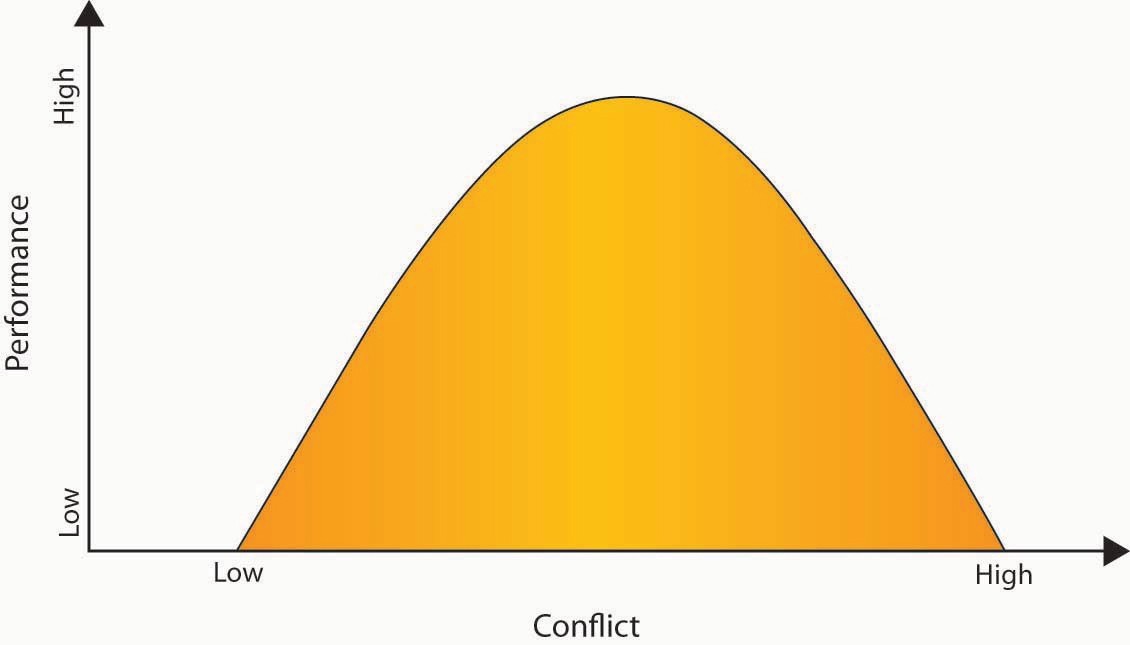
Most people are uncomfortable with disharmonize, but is conflict always bad? Disharmonize can exist dysfunctional if it paralyzes an organization, leads to less than optimal performance, or, in the worst example, leads to workplace violence. Surprisingly, a moderate amount of conflict can really be a good for you (and necessary) role of organizational life (Amason, 1996). To understand how to become to a positive level of conflict, we need to understand its root causes, consequences, and tools to assistance manage information technology. The impact of too much or besides petty conflict can disrupt performance. If conflict is as well depression, so performance is low. If conflict is as well high, then performance too tends to exist low. The goal is to hold conflict levels in the middle of this range. While it might seem foreign to want a particular level of conflict, a medium level of task-related disharmonize is oftentimes viewed as optimal, because information technology represents a situation in which a healthy contend of ideas takes place.
 Job conflict can exist adept in certain circumstances, such as in the early stages of decision making, because it stimulates creativity. Withal, information technology tin can interfere with circuitous tasks in the long run (De Dreu & Weingart, 2003). Personal conflicts, such equally personal attacks, are never healthy considering they crusade stress and distress, which undermines performance. The worst cases of personal conflicts can lead to workplace bullying. At Intel Corporation, all new employees go through a 4-hr training module to acquire "constructive confrontation." The content of the training program includes dealing with others in a positive manner, using facts rather than opinion to persuade others, and focusing on the problem at hand rather than the people involved. "Nosotros don't spend fourth dimension existence defensive or taking things personally. We cut through all of that and get to the issues," notes a trainer from Intel University (Dahle, 2001). The success of the training remains unclear, merely the presence of this program indicates that Intel understands the potentially positive result of a moderate level of conflict. Research focusing on constructive teams across time establish that they were characterized past low but increasing levels of process disharmonize (how do we become things done?), low levels of relationship conflict with a rise toward the finish of the project (personal disagreements amid team members), and moderate levels of task conflict in the middle of the job time line (Jehn & Mannix, 2001).
10.3 Causes and Outcomes of Conflict
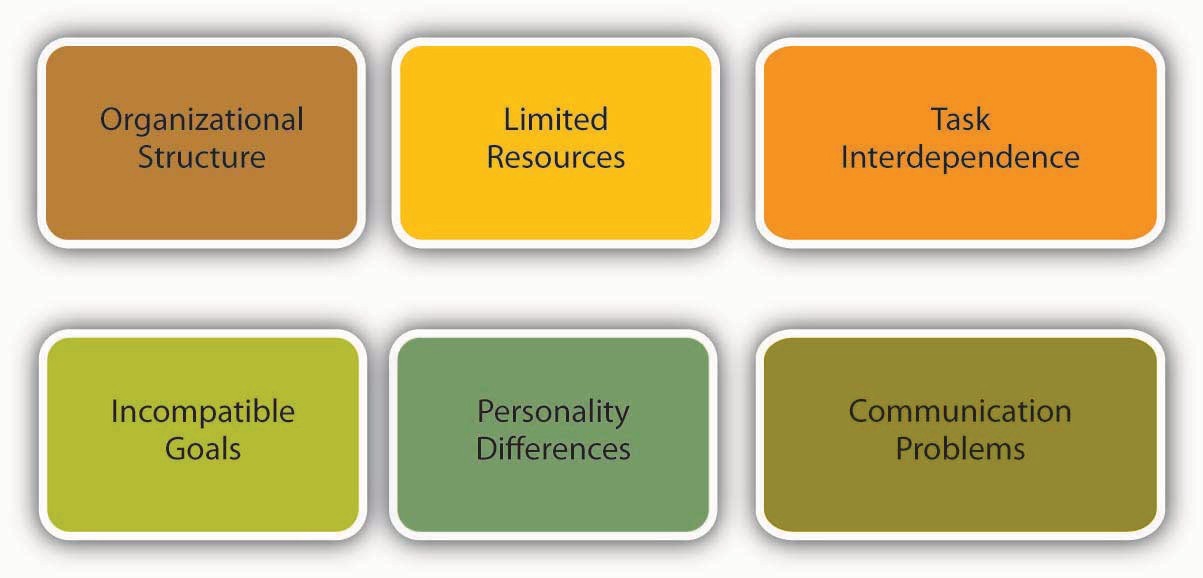
There are many potential root causes of disharmonize at piece of work. We'll go over vi of them here. Remember, anything that leads to a disagreement can be a cause of conflict. Although conflict is common to organizations, some organizations have more than others.
System Construction
Disharmonize tends to have dissimilar forms, depending upon the organizational structure (Jaffe, 2000). For case, if a company uses a matrix structure as its organizational form, it will take decisional conflict congenital in, because the construction specifies that each manager report to two bosses. For example, global company ABB Inc. is organized around a matrix structure based on the dimensions of land and manufacture. This structure tin can lead to defoliation as the company is divided geographically into 1,200 different units and by manufacture into 50 unlike units (Taylor, 1991).
Limited Resources
Resources such as money, fourth dimension, and equipment are often scarce. Competition amongst people or departments for limited resource is a frequent cause for conflict. For example, cutting-edge laptops and gadgets such as a BlackBerry or iPhone are expensive resources that may exist allocated to employees on a need-to-have basis in some companies. When a group of employees have access to such resources while others do not, disharmonize may arise amongst employees or between employees and direction. While technical employees may feel that these devices are crucial to their productivity, employees with customer contact such as sales representatives may brand the indicate that these devices are important for them to brand a good impression to clients. Because important resources are frequently limited, this is one source of conflict many companies have to live with.
Task Interdependence
Another crusade of conflict is chore interdependence; that is, when achievement of your goal requires reliance on others to perform their tasks. For example, if you're tasked with creating advertising for your product, you're dependent on the creative team to design the words and layout, the photographer or videographer to create the visuals, the media buyer to purchase the advertising infinite, and so on. The completion of your goal (ambulation or publishing your advertizing) is dependent on others.
Incompatible Goals
Sometimes conflict arises when 2 parties recollect that their goals are mutually exclusive. Inside an arrangement, incompatible goals frequently arise considering of the different ways section managers are compensated. For instance, a sales manager'due south bonus may be tied to how many sales are made for the company. As a effect, the individual might be tempted to offer customers "freebies" such equally expedited delivery in guild to brand the sale. In contrast, a transportation manager's bounty may be based on how much money the company saves on transit. In this case, the goal might be to eliminate expedited delivery considering it adds expense. The ii will butt heads until the company resolves the disharmonize by changing the compensation scheme. For example, if the company assigns the bonus based on profitability of a sale, non just the dollar amount, the toll of the expediting would exist subtracted from the value of the sale. It might still make sense to expedite the order if the sale is big enough, in which case both parties would support it. On the other hand, if the expediting negates the value of the auction, neither party would be in favor of the added expense.
Personality Differences
Personality differences amidst coworkers are mutual. Past understanding some key differences among the way people recollect and human activity, we tin can better understand how others see the world. Knowing that these differences are natural and normal let's conceptualize and mitigate interpersonal conflict—it's often not about "you lot" just merely a dissimilar fashion of seeing and behaving. For instance, Type A individuals accept been found to have more than conflicts with their coworkers than Blazon B individuals (Businesswoman, 1989).
Communication Bug
Sometimes conflict arises simply out of a small-scale, unintentional advice problem, such as lost emails or dealing with people who don't return telephone calls. Giving feedback is likewise a case in which the best intentions can quickly escalate into a disharmonize situation. When communicating, exist certain to focus on behaviour and its effects, not on the person. For example, say that Jeff always arrives late to all your meetings. You lot call up he has a bad attitude, simply yous don't really know what Jeff's mental attitude is. You do know, however, the effect that Jeff'south behaviour has on you lot. You could say, "Jeff, when you come late to the meeting, I experience like my time is wasted." Jeff can't fence with that statement, considering information technology is a fact of the bear on of his behaviour on yous. It's indisputable, because information technology is your reality. What Jeff tin say is that he did not intend such an effect, and then you can have a discussion regarding the behaviour.
Outcomes of Conflict
One of the virtually common outcomes of conflict is that it upsets parties in the short run (Bergman & Volkema, 1989). However, conflict tin accept both positive and negative outcomes. On the positive side, conflict tin result in greater creativity or better decisions. For example, as a result of a disagreement over a policy, a manager may learn from an employee that newer technologies help solve problems in an unanticipated new fashion.
Positive outcomes include the following:
- Consideration of a broader range of ideas, resulting in a amend, stronger idea
- Surfacing of assumptions that may be inaccurate
- Increased participation and inventiveness
- Clarification of private views that build learning
On the other manus, conflict tin exist dysfunctional if it is excessive or involves personal attacks or underhanded tactics.
Examples of negative outcomes include the post-obit:
- Increased stress and anxiety among individuals, which decreases productivity and satisfaction
- Feelings of beingness defeated and demeaned, which lowers individuals' morale and may increment turnover
- A climate of mistrust, which hinders the teamwork and cooperation necessary to get work done
Given these negative outcomes, how can conflict be managed and so that information technology does not become dysfunctional or fifty-fifty unsafe? We'll explore this in the next section.
ten.four Conflict Management
In that location are a number of different ways of managing organizational conflict, which are highlighted in this section. Conflict direction refers to resolving disagreements finer.
Ways to Manage Disharmonize
Alter the Structure
When construction is a cause of dysfunctional conflict, structural change tin be the solution to resolving the conflict. Consider this situation. Vanessa, the lead engineer in charge of new production development, has submitted her components list to Tom, the procurement officer, for purchasing. Tom, as usual, has rejected two of the central components, refusing the expenditure on the purchase. Vanessa is furious, proverb, "Every time I give you a request to buy a new part, you fight me on it. Why tin can't you e'er trust my judgment and accolade my request?"
Tom counters, "You're ever choosing the newest, leading-border parts—they're hard to find and expensive to purchase. I'g supposed to go along costs downwardly, and your requests always intermission my upkeep."
"But when you don't social club the parts we demand for a new product, yous filibuster the whole projection," Vanessa says.
Sharon, the business unit'south vice president, hits upon a structural solution by stating, "From now on, both of you will be evaluated on the total cost and the overall performance of the product. You need to piece of work together to keep component costs low while minimizing quality bug after." If the conflict is at an intergroup level, such as between 2 departments, a structural solution could be to have those ii departments report to the same executive, who could align their previously incompatible goals.
Change the Composition of the Team
If the conflict is between squad members, the easiest solution may be to change the composition of the team, separating the personalities that were at odds. In instances in which disharmonize is attributed to the widely dissimilar styles, values, and preferences of a small number of members, replacing some of these members may resolve the problem. If that's not possible because everyone'due south skills are needed on the team and substitutes aren't available, consider a concrete layout solution. Enquiry has shown that when known antagonists are seated direct across from each other, the amount of conflict increases. Withal, when they are seated next, the conflict tends to subtract (Gordon et al., 1990).
Create a Common Opposing Force
Group conflict within an system can be mitigated past focusing attention on a common enemy such as the competition. For example, two software groups may be vying confronting each other for marketing dollars, each wanting to maximize advertising money devoted to their product. Merely, by focusing attention on a competitor company, the groups may make up one's mind to work together to enhance the marketing effectiveness for the company equally a whole. The "enemy" need not exist some other company—it could exist a concept, such equally a recession, that unites previously warring departments to relieve jobs during a downturn.
Consider Majority Rule
Sometimes a group conflict tin exist resolved through majority dominion. That is, group members have a vote, and the idea with the about votes is the one that gets implemented. The majority rule arroyo can work if the participants feel that the process is off-white. It is important to keep in mind that this strategy will become ineffective if used repeatedly with the same members typically winning. Moreover, the arroyo should be used sparingly. It should follow a good for you discussion of the issues and points of contention, not be a substitute for that discussion.
Trouble Solve
Problem solving is a common approach to resolving conflict. In trouble-solving fashion, the individuals or groups in conflict are asked to focus on the problem, non on each other, and to uncover the root crusade of the problem. This approach recognizes the rarity of one side existence completely right and the other beingness completely wrong.
Disharmonize-Handling Styles
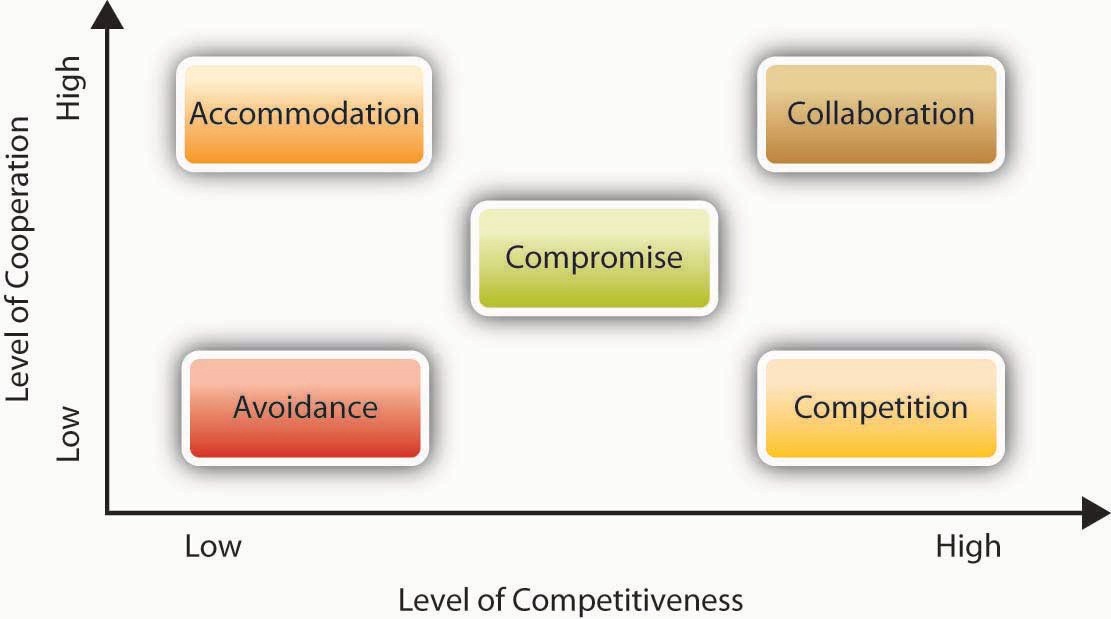
Individuals vary in the way that they handle conflicts. There are five mutual styles of handling conflicts. These styles tin can be mapped onto a grid that shows the varying caste of cooperation and assertiveness each fashion entails. Allow usa look at each in plow.
Abstention
The avoiding style is uncooperative and unassertive. People exhibiting this style seek to avoid conflict altogether by denying that information technology is there. They are decumbent to postponing any decisions in which a disharmonize may ascend. People using this fashion may say things such as, "I don't really care if nosotros piece of work this out," or "I don't think there's any problem. I feel fine about how things are." Conflict avoidance may be habitual to some people because of personality traits such as the need for affiliation. While disharmonize avoidance may not be a pregnant problem if the issue at manus is trivial, it becomes a problem when individuals avert confronting important issues because of a dislike for disharmonize or a perceived disability to handle the other party's reactions.
Accommodation
The accommodating style is cooperative and unassertive. In this style, the person gives in to what the other side wants, even if it means giving up one's personal goals. People who employ this style may fright speaking up for themselves or they may identify a higher value on the relationship, believing that disagreeing with an idea might be hurtful to the other person. They will say things such as, "Let's practise it your manner" or "If it'south important to y'all, I can continue with information technology." Adaptation may be an effective strategy if the issue at hand is more of import to others compared to oneself. Yet, if a person perpetually uses this style, that individual may start to see that personal interests and well-beingness are neglected.
Compromise
The compromising style is a eye-basis style, in which individuals take some desire to express their ain concerns and get their way but nevertheless respect the other person's goals. The compromiser may say things such as, "Maybe I ought to reconsider my initial position" or "Maybe we tin both agree to give in a little." In a compromise, each person sacrifices something valuable to them. For example, in 2005 the luxurious Lanesborough Hotel in London advertised incorrect nightly rates for £35, equally opposed to £350. When the hotel received a large number of online bookings at this charge per unit, the initial reaction was to insist that customers abolish their reservations and book at the correct charge per unit. The situation was nigh to pb to a public relations crunch. As a result, they agreed to book the rooms at the advertised price for a maximum of three nights, thereby limiting the damage to the hotel'due south bottom line as well equally its reputation (Horowitz et al., 2006).
Competition

People exhibiting a competing manner want to reach their goal or become their solution adopted regardless of what others say or how they feel. They are more interested in getting the outcome they want equally opposed to keeping the other political party happy, and they push for the deal they are interested in making. Contest may lead to poor relationships with others if 1 is always seeking to maximize their own outcomes at the expense of others' well-existence. This approach may be constructive if one has potent moral objections to the alternatives or if the alternatives one is opposing are unethical or harmful.
Collaboration
The collaborating manner is high on both assertiveness and cooperation. This is a strategy to use for achieving the best outcome from conflict—both sides contend for their position, supporting information technology with facts and rationale while listening intently to the other side. The objective is to notice a win–win solution to the problem in which both parties become what they want. They'll claiming points only non each other. They'll emphasize problem solving and integration of each other's goals. For case, an employee who wants to complete an MBA program may have a conflict with direction when he wants to reduce his work hours. Instead of taking opposing positions in which the employee defends his need to pursue his career goals while the manager emphasizes the company'southward demand for the employee, both parties may review alternatives to detect an integrated solution. In the terminate, the employee may determine to pursue the degree while taking online classes, and the company may realize that paying for the employee's tuition is a worthwhile investment. This may be a win–win solution to the problem in which no i gives upwards what is personally important, and every party gains something from the exchange.
Which Mode Is Best?
Like much of organizational behaviour, there is no one "right way" to deal with disharmonize. Much of the fourth dimension information technology volition depend on the situation. Nonetheless, the collaborative manner has the potential to be highly effective in many different situations.
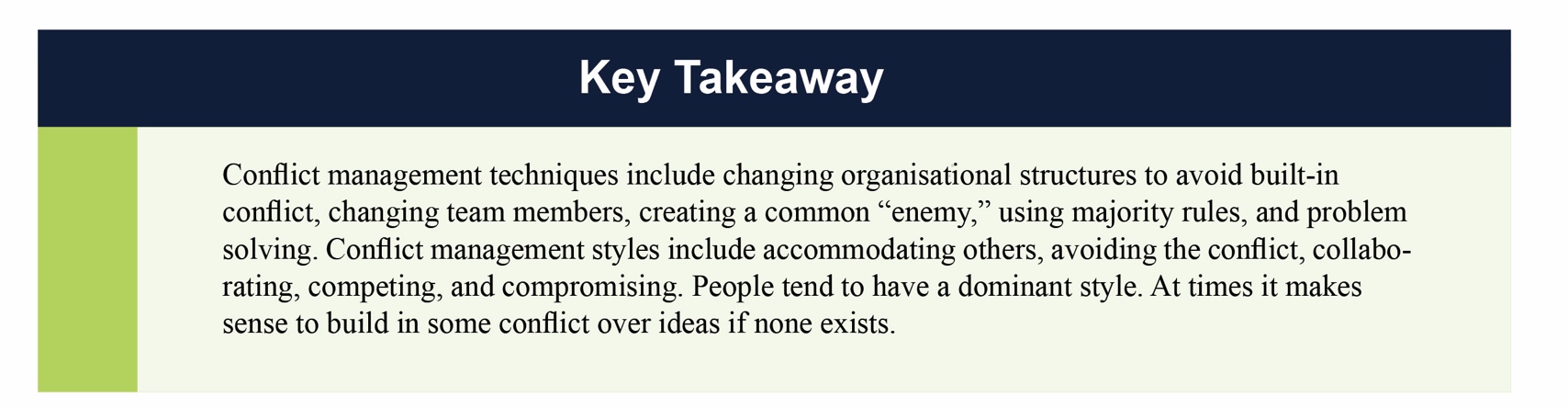
 We practise know that well-nigh individuals have a ascendant way that they tend to use most often. Call up of your friend who is e'er looking for a fight or your coworker who always backs down from a disagreement. Successful individuals are able to match their mode to the state of affairs. There are times when avoiding a conflict tin be a groovy option. For case, if a driver cuts y'all off in traffic, ignoring it and going on with your day is a good alternative to "route rage." Nevertheless, if a colleague keeps challenge buying of your ideas, information technology may be fourth dimension for a confrontation. Assuasive such intellectual plagiarism to go along could easily exist more destructive to your career than confronting the individual. Enquiry also shows that when it comes to dealing with conflict, managers prefer forcing, while their subordinates are more likely to engage in avoiding, accommodating, or compromising (Howat & London, 1980). It is also likely that individuals will answer similarly to the person engaging in disharmonize. For instance, if 1 person is forcing, others are likely to answer with a forcing tactic equally well.
ten.5 Negotiations
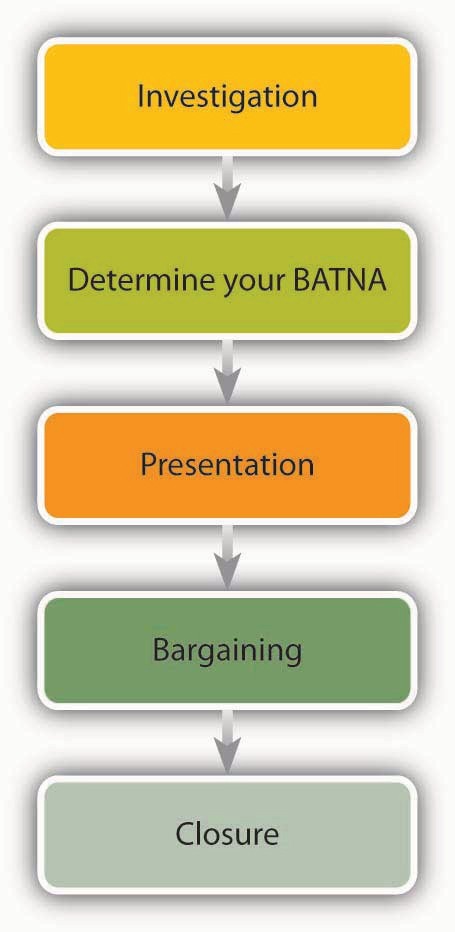
A common manner that parties deal with conflict is via negotiation. Negotiation is a process whereby two or more parties piece of work toward an agreement. At that place are v phases of negotiation, which are described below.
The Five Phases of Negotiation
Stage 1: Investigation
The outset step in negotiation is the investigation, or information gathering phase. This is a key stage that is frequently ignored. Surprisingly, the kickoff place to begin is with yourself: What are your goals for the negotiation? What practice you want to achieve? What would yous concede? What would you admittedly not concede? Leigh Steinberg, the almost powerful agent in sports (he was the role model for Tom Cruise'southward grapheme in Jerry Maguire), puts information technology this way: "You need the clearest possible view of your goals. And you need to be brutally honest with yourself about your priorities" (Webber, 1998).
During the negotiation, you lot'll inevitably be faced with making choices. It's best to know what you want, so that in the heat of the moment you're able to make the best determination. For example, if you'll be negotiating for a new job, enquire yourself, "What practise I value most? Is it the salary level? Working with coworkers whom I like? Working at a prestigious company? Working in a certain geographic area? Exercise I want a company that volition groom me for futurity positions or exercise I want to change jobs often in pursuit of new challenges?"
Stage ii: Make up one's mind Your BATNA
"If you don't know where you're going, yous will probably stop up somewhere else."
– Lawrence J. Peter
I important role of the investigation and planning phase is to determine your BATNA, which is an acronym that stands for the "best culling to a negotiated agreement." Roger Fisher and William Ury coined this phrase in their volume Getting to Yes: Negotiating without Giving In.
Thinking through your BATNA is important to helping y'all make up one's mind whether to take an offer you receive during the negotiation. Yous demand to know what your alternatives are. If you lot accept various alternatives, you can look at the proposed deal more than critically. Could you lot become a better outcome than the proposed deal? Your BATNA will help you reject an unfavorable deal. On the other manus, if the deal is better than another outcome you could get (that is, ameliorate than your BATNA), then you should take it.
Think about it in common sense terms: When you know your opponent is drastic for a deal, you can need much more than. If information technology looks like they have a lot of other options outside the negotiation, yous'll be more likely to make concessions.
As Fisher and Ury said, "The reason you negotiate is to produce something better than the results y'all can obtain without negotiating. What are those results? What is that alternative? What is your BATNA—your Best Alternative To a Negotiated Agreement? That is the standard against which whatever proposed agreement should exist measured" (Fisher & Ury, 1981).
The political party with the best BATNA has the best negotiating position, so try to improve your BATNA whenever possible past exploring possible alternatives (Pinkley, 1995).
Going back to the example of your new job negotiation, consider your options to the offering yous receive. If your pay is lower than what you want, what alternatives do you have? A job with another company? Looking for another task? Going back to school? While yous're thinking nearly your BATNA, take some time to call up most the other party's BATNA. Practice they have an employee who could readily replace you lot?
Once yous've gotten a clear understanding of your own goals, investigate the person you'll be negotiating with. What does that person (or company) desire? Put yourself in the other party's shoes. What alternatives could they have? For example, in the job negotiations, the other side wants a adept employee at a fair price. That may lead y'all to do research on salary levels: What is the pay rate for the position you're seeking? What is the civilisation of the company?
Greenpeace's goals are to safeguard the environment past getting large companies and organizations to prefer more environmentally friendly practices such as using fewer plastic components. Office of the groundwork inquiry Greenpeace engages in involves uncovering facts. For instance, medical device makers are using harmful PVCs as a tubing material because PVCs are inexpensive. But are at that place alternatives to PVCs that are also cost-effective? Greenpeace'southward research found that yep, there are (Layne, 1999). Knowing this lets Greenpeace counter those arguments and puts Greenpeace in a stronger position to achieve its goals.
Phase 3: Presentation

The third stage of negotiation is presentation. In this phase, you assemble the information you lot've gathered in a way that supports your position. In a task hiring or salary negotiation situation, for example, you can present facts that show what y'all've contributed to the organization in the past (or in a previous position), which in turn demonstrates your value. Perhaps y'all created a blog that brought attention to your company or got donations or funding for a charity. Perchance you're a team player who brings out the best in a group.
Stage four: Bargaining
During the bargaining phase, each political party discusses their goals and seeks to go an understanding. A natural part of this process is making concessions, namely, giving up ane thing to become something else in return. Making a concession is non a sign of weakness—parties expect to give upward some of their goals. Rather, concessions demonstrate cooperativeness and assistance move the negotiation toward its conclusion. Making concessions is particularly important in tense union-management disputes, which can get bogged down by old issues. Making a concession shows forward movement and process, and it allays concerns about rigidity or airtight-mindedness. What would a typical concession be? Concessions are often in the areas of money, time, resource, responsibilities, or autonomy. When negotiating for the buy of products, for example, you might agree to pay a higher price in exchange for getting the products sooner. Alternatively, you could inquire to pay a lower cost in commutation for giving the manufacturer more time or flexibility in when they deliver the product.
Ane key to the bargaining phase is to enquire questions. Don't simply take a statement such every bit "we can't practise that" at face value. Rather, try to find out why the party has that constraint. Let'south take a look at an case. Say that y'all're a retailer and yous want to buy patio furniture from a manufacturer. You want to have the sets in fourth dimension for leap sales. During the negotiations, your goal is to get the lowest price with the earliest delivery date. The manufacturer, of course, wants to become the highest price with the longest lead time before delivery. As negotiations stall, you lot evaluate your options to decide what'south more important: a slightly lower price or a slightly longer delivery date? Y'all exercise a quick calculation. The manufacturer has offered to evangelize the products by Apr 30, but you know that some of your customers make their patio furniture selection early on in the jump, and missing those early sales could toll you $1 1000000. So, yous suggest that you can take the April 30 delivery date if the manufacturer volition hold to drop the price by $1 million.
"I appreciate the offer," the manufacturer replies, "simply I can't suit such a large cost cut." Instead of leaving it at that, you ask, "I'g surprised that a ii-calendar month delivery would be so costly to you. Tell me more about your manufacturing process so that I can understand why you can't industry the products in that time frame."
"Manufacturing the products in that time frame is not the trouble," the manufacturer replies, "but getting them shipped from Asia is what's expensive for us."
When you hear that, a light bulb goes off. You know that your firm has favorable contracts with shipping companies because of the loftier volume of business organization the house gives them. You make the following counteroffer: "Why don't we concur that my company will accommodate and pay for the shipper, and you concur to have the products ready to send on March thirty for $10.5 million instead of $11 1000000?" The manufacturer accepts the offer—the biggest expense and constraint (the aircraft) has been lifted. You, in plow, have saved money as well (Malhotra & Bazerman, 2007).
Phase 5: Closure
Closure is an of import role of negotiations. At the close of a negotiation, y'all and the other party take either come up to an agreement on the terms, or one party has decided that the terminal offer is unacceptable and therefore must walked away. About negotiators assume that if their best offer has been rejected, there'due south zippo left to do. You made your best offer and that'southward the best you lot tin can do. The savviest of negotiators, however, see the rejection every bit an opportunity to learn. "What would it take taken for u.s. to reach an agreement?"
Recently, a CEO had been in negotiations with a client. After learning the customer decided to go with the contest, the CEO decided to inquire as to why negotiations had fallen through. With nothing left to lose, the CEO placed a call to the prospect'due south vice president and asked why the offer had been rejected, explaining that the reply would assistance improve future offerings. Surprisingly, the VP explained the deal was given to the competitor because, despite charging more, the competitor offered after-sales service on the production. The CEO was taken past surprise, originally bold that the VP was most interested in obtaining the everyman toll possible. In social club to accommodate a very low cost, various extras such equally after-sales service had been cutting from the offer. Having learned that the VP was seeking service, not the lowest toll, the CEO said, "Knowing what I know at present, I'm confident that I could have browbeaten the competitor's bid. Would you accept a revised offering?" The VP agreed, and a week later on the CEO had a signed contract (Malhotra & Bazerman, 2007).
Sometimes at the cease of negotiations, it'southward clear why a bargain was non reached. But if y'all're confused about why a deal did non happen, consider making a follow-up call. Even though you may not win the bargain back in the end, you might learn something that's useful for future negotiations. What's more, the other party may be more than willing to disembalm the information if they don't think you're in a "selling" manner.
When All Else Fails: Third-Party Negotiations
Culling Dispute Resolution
Culling Dispute Resolution (ADR) includes arbitration, arbitration, and other means of resolving conflicts with the help of a particularly trained, neutral third party without the need for a formal trial or hearing (New York State Unified Court System, 2008). Many companies detect this effective in dealing with challenging problems. For instance, Eastman Kodak Company added an alternative dispute resolution panel of internal employees to assist them handle cases of perceived bigotry and hopefully terminate a conflict from escalating (Deutsch, 2004).
Arbitration
In mediation, an outside third party (the mediator) enters the situation with the goal of assisting the parties in reaching an agreement. The mediator can facilitate, advise, and recommend. The mediator works with both parties to reach a solution but does not represent either side. Rather, the mediator'due south role is to assistance the parties share feelings, air and verify facts, substitution perceptions, and work toward agreements. Susan Podziba, a mediation expert, has helped get groups that sometimes have a hard time seeing the other side's point of view to open up and talk to one another. Her piece of work includes such groups as pro-pick and pro-life advocates, individuals from Israel and Palestine, also equally fishermen and environmentalists.
Arbitration
In contrast to mediation, in which parties work with the mediator to arrive at a solution, in arbitration the parties submit the dispute to the third-party arbitrator. It is the arbitrator who makes the final decision. The arbitrator is a neutral third party, but the conclusion made by the arbitrator is concluding (the decision is called the "award"). Awards are made in writing and are binding to the parties involved in the example (American Arbitration Association, 2007). Arbitration is often used in marriage-management grievance conflicts.
10.6 Decision
Conflict can run the gamut from minor annoyances to physically fierce situations. At the aforementioned time, conflict can increase creativity and innovation, or information technology can bring organizations to a grinding halt. There are many different types of conflict, including interpersonal, intrapersonal, and intergroup. Within organizations, there are many common situations that can spur conflict. Certain organizational structures, such every bit a matrix structure, can cause whatever given employee to accept multiple bosses and alien or overwhelming demands. A scarcity of resource for employees to complete tasks is another common cause of organizational conflict, particularly if groups inside the system compete over those resources. Of class, uncomplicated personality clashes can create interpersonal conflict in whatsoever state of affairs. Communication issues are likewise a very mutual source of conflict even when no actual problem would exist otherwise. When conflict arises, it tin exist handled past any number of methods, each with varying degrees of cooperation and competitiveness. Different situations require different conflict handling methods, and no i method is best.
Negotiations occur during many important processes and possessing astute negotiation skills tin can be an incredible tool. A key component to negotiations involves having a BATNA, or "best alternative to a negotiated understanding." Negotiations typically move through five phases, including investigation, determining your BATNA, presentation, bargaining, and closure. During a negotiation, it is of import not to make whatever number of common mistakes. These mistakes tin include accepting the first offer, letting ego go in the way, having unrealistic expectations of the outcome of the negotiation, becoming likewise emotional during the process, or existence weighed down past previous failures and letting the past repeat itself. It is important to proceed in mind that many cultures accept preferential methods for treatment conflict and negotiation. Individuals should empathise the cultural background of others to amend navigate what could otherwise become a messy situation.10.7 Exercises
Source: https://pressbooks.senecacollege.ca/organizationalbehaviour/chapter/chapter-10/
0 Response to "What Does Conflict Mean What Is the Conflict in Inside Out and Back Again"
Post a Comment