Can a President Who Has Served Two Terms Run Again
The Twenty-2nd Amendment (Amendment XXII) to the United States Constitution limits the number of times a person is eligible for ballot to the function of President of the Usa to two, and sets additional eligibility atmospheric condition for presidents who succeed to the unexpired terms of their predecessors.[1] Congress approved the 20-second Amendment on March 21, 1947, and submitted information technology to the state legislatures for ratification. That procedure was completed on February 27, 1951, when the requisite 36 of the 48 states had ratified the amendment (neither Alaska nor Hawaii had yet been admitted equally states), and its provisions came into force on that appointment.
The amendment prohibits anyone who has been elected president twice from being elected again. Under the amendment, someone who fills an unexpired presidential term lasting more two years is besides prohibited from beingness elected president more once. Scholars debate whether the amendment prohibits afflicted individuals from succeeding to the presidency under whatsoever circumstances or whether it applies merely to presidential elections. Until the amendment'due south ratification, the president had not been subject to term limits, but both George Washington and Thomas Jefferson (the kickoff and third presidents) decided not to serve a third term, establishing a 2-term tradition that subsequent presidents followed. In the 1940 and 1944 presidential elections, Franklin D. Roosevelt became the kickoff president to win tertiary and quaternary terms, giving rise to concerns about a president serving unlimited terms.[2]
Text [edit]
Department 1. No person shall be elected to the part of the President more than twice, and no person who has held the part of President, or acted as President, for more than two years of a term to which some other person was elected President shall be elected to the office of the President more than than once. But this Article shall not apply to whatsoever person holding the office of President when this Article was proposed by the Congress, and shall not prevent any person who may be property the part of President, or interim every bit President, during the term inside which this Article becomes operative from property the role of President or acting as President during the remainder of such term.
Department 2. This Article shall be inoperative unless it shall have been ratified equally an amendment to the Constitution by the legislatures of iii-fourths of the several states inside seven years from the date of its submission to us past the Congress.[three]
Groundwork [edit]
The Twenty-2nd Amendment was a reaction to Franklin D. Roosevelt's ballot to an unprecedented four terms equally president, but presidential term limits had long been debated in American politics. Delegates to the Constitutional Convention of 1787 considered the result extensively (aslope broader questions, such as who would elect the president, and the president's office). Many, including Alexander Hamilton and James Madison, supported lifetime tenure for presidents, while others favored fixed terms. Virginia'southward George Mason denounced the life-tenure proposal equally tantamount to elective monarchy.[4] An early draft of the U.Southward. Constitution provided that the president was restricted to one 7-year term.[5] Ultimately, the Framers approved 4-year terms with no brake on how many times a person could be elected president.
Though dismissed by the Ramble Convention, term limits for U.S. presidents were contemplated during the presidencies of George Washington and Thomas Jefferson. As his second term entered its terminal year in 1796, Washington was exhausted from years of public service, and his health had begun to refuse. He was also bothered by his political opponents' unrelenting attacks, which had escalated after the signing of the Jay Treaty, and believed he had accomplished his major goals equally president. For these reasons, he decided not to run for a third term, a decision he announced to the nation in his September 1796 Farewell Accost.[half-dozen] Eleven years later on, as Thomas Jefferson neared the halfway point of his second term, he wrote,
If some termination to the services of the principal magistrate be not fixed by the Constitution, or supplied past practice, his office, nominally for years, volition in fact, become for life; and history shows how easily that degenerates into an inheritance.[vii]
Since Washington made his historic announcement, numerous academics and public figures have looked at his determination to retire after two terms, and take, according to political scientist Bruce Peabody, "argued he had established a two-term tradition that served as a vital check against any one person, or the presidency as a whole, accumulating too much power".[8] Various amendments aimed at changing informal precedent to constitutional constabulary were proposed in Congress in the early to mid-19th century, but none passed.[4] [9] Iii of the adjacent 4 presidents after Jefferson—James Madison, James Monroe, and Andrew Jackson—served ii terms, and each adhered to the 2-term principle;[1] Martin Van Buren was the only president between Jackson and Abraham Lincoln to be nominated for a second term, though he lost the 1840 election and and then served only one term.[9] At the starting time of the Ceremonious War the seceding States drafted the Constitution of the Amalgamated States of America, which in near respects resembled the United States Constitution, but limited the president to a single six-year term.

In spite of the stiff 2-term tradition, a few presidents before Roosevelt attempted to secure a 3rd term. Following Ulysses S. Grant's reelection in 1872, there were serious discussions within Republican political circles near the possibility of his running again in 1876. But interest in a 3rd term for Grant evaporated in the lite of negative public opinion and opposition from members of Congress, and Grant left the presidency in 1877 subsequently two terms. However, as the 1880 ballot approached, he sought nomination for a (non-consecutive) third term at the 1880 Republican National Convention, but narrowly lost to James Garfield, who won the 1880 election.[9]
Theodore Roosevelt succeeded to the presidency on September fourteen, 1901, following William McKinley'south bump-off (194 days into his 2nd term), and was handily elected to a full term in 1904. He declined to seek a 3rd (second full) term in 1908, but did run again in the election of 1912, losing to Woodrow Wilson. Wilson himself, despite his sick health following a serious stroke, aspired to a third term. Many of his directorate tried to convince him that his health precluded another campaign, but Wilson nonetheless asked that his name be placed in nomination for the presidency at the 1920 Democratic National Convention.[10] Autonomous Political party leaders were unwilling to back up Wilson, and the nomination went to James 1000. Cox, who lost to Warren K. Harding. Wilson again contemplated running for a (nonconsecutive) tertiary term in 1924, devising a strategy for his comeback, but again lacked whatsoever back up; he died in Feb of that twelvemonth.[11]
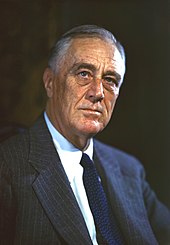
Franklin Roosevelt spent the months leading upwardly to the 1940 Democratic National Convention refusing to say whether he would seek a third term. His Vice President, John Nance Garner, along with Postmaster General James Farley, announced their candidacies for the Democratic nomination. When the convention came, Roosevelt sent a bulletin to the convention saying he would run only if drafted, proverb delegates were gratis to vote for whomever they pleased. This message was interpreted to mean he was willing to exist drafted, and he was renominated on the convention's get-go ballot.[ix] [12] Roosevelt won a decisive victory over Republican Wendell Willkie, condign the first (and to date only) president to exceed 8 years in office. His decision to seek a third term dominated the ballot entrada.[13] Willkie ran against the open-ended presidential tenure, while Democrats cited the war in Europe every bit a reason for breaking with precedent.[9]
Four years later, Roosevelt faced Republican Thomas Eastward. Dewey in the 1944 election. Most the stop of the campaign, Dewey announced his support of a constitutional subpoena to limit presidents to two terms. According to Dewey, "iv terms, or 16 years (a straight reference to the president'south tenure in function four years hence), is the well-nigh dangerous threat to our freedom ever proposed."[14] He also discreetly raised the issue of the president'south age. Roosevelt exuded plenty free energy and charisma to retain voters' confidence and was elected to a fourth term.[15]
While he quelled rumors of poor health during the entrada, Roosevelt'due south wellness was deteriorating. On Apr 12, 1945, only 82 days after his 4th inauguration, he suffered a cognitive hemorrhage and died, to be succeeded by Vice President Harry Truman.[sixteen] In the midterm elections 18 months later, Republicans took control of the Firm and the Senate. Equally many of them had campaigned on the consequence of presidential tenure, declaring their support for a ramble amendment that would limit how long a person could serve every bit president, the issue was given priority in the 80th Congress when it convened in January 1947.[8]
Proposal and ratification [edit]
Proposal in Congress [edit]
The House of Representatives took quick activity, approving a proposed constitutional amendment (House Joint Resolution 27) setting a limit of two four-year terms for future presidents. Introduced by Earl C. Michener, the measure passed 285–121, with support from 47 Democrats, on February half dozen, 1947.[17] Meanwhile, the Senate developed its ain proposed amendment, which initially differed from the Firm proposal by requiring that the amendment be submitted to state ratifying conventions for ratification, rather than to the country legislatures, and by prohibiting any person who had served more than 365 days in each of ii terms from farther presidential service. Both these provisions were removed when the total Senate took up the nib, but a new provision was, however, added. Put forrad by Robert A. Taft, it clarified procedures governing the number of times a vice president who succeeded to the presidency might be elected to function. The amended proposal was passed 59–23, with 16 Democrats in favor, on March 12.[1] [18]
On March 21, the Firm agreed to the Senate's revisions and approved the resolution to amend the Constitution. Afterward, the subpoena imposing term limitations on futurity presidents was submitted to u.s. for ratification. The ratification process was completed on February 27, 1951, 3 years, 343 days afterward it was sent to united states.[19] [xx]
Ratification by united states of america [edit]

A map of how u.s. voted on the Twenty-second Amendment

In one case submitted to us, the 22nd Amendment was ratified by:[3]
- Maine: March 31, 1947
- Michigan: March 31, 1947
- Iowa: April i, 1947
- Kansas: April 1, 1947
- New Hampshire: April one, 1947
- Delaware: April two, 1947
- Illinois: April 3, 1947
- Oregon: April 3, 1947
- Colorado: April 12, 1947
- California: April 15, 1947
- New Bailiwick of jersey: April xv, 1947
- Vermont: April 15, 1947
- Ohio: Apr 16, 1947
- Wisconsin: April sixteen, 1947
- Pennsylvania: April 29, 1947
- Connecticut: May 21, 1947
- Missouri: May 22, 1947
- Nebraska: May 23, 1947
- Virginia: January 28, 1948
- Mississippi: February 12, 1948
- New York: March 9, 1948
- Southward Dakota: January 21, 1949
- Northward Dakota: Feb 25, 1949
- Louisiana: May 17, 1950
- Montana: January 25, 1951
- Indiana: Jan 29, 1951
- Idaho: January 30, 1951
- New Mexico: February 12, 1951
- Wyoming: Feb 12, 1951
- Arkansas: Feb 15, 1951
- Georgia: February 17, 1951
- Tennessee: February 20, 1951
- Texas: February 22, 1951
- Utah: Feb 26, 1951
- Nevada: February 26, 1951
- Minnesota: February 27, 1951
Ratification was completed when the Minnesota Legislature ratified the subpoena. On March 1, 1951, the Administrator of General Services, Jess Larson, issued a certificate proclaiming the 22nd Amendment duly ratified and part of the Constitution. The amendment was subsequently ratified by:[3] - Due north Carolina: February 28, 1951
- South Carolina: March 13, 1951
- Maryland: March 14, 1951
- Florida: Apr 16, 1951
- Alabama: May 4, 1951
Conversely, two states—Oklahoma and Massachusetts—rejected the amendment, while five (Arizona, Kentucky, Rhode Island, Washington, and West Virginia) took no action.[18]
Effect [edit]
Considering of the grandfather clause in Section 1, the amendment did non apply to Harry Due south. Truman, as he was the incumbent president at the time it came into forcefulness. Truman, who had served most all of Franklin Roosevelt'due south unexpired fourth term and who was elected to a full term in 1948, was thus eligible for reelection in 1952.[13] Just with his job approving rating at around 27%,[21] [22] and after a poor performance in the 1952 New Hampshire primary, Truman chose not to seek his party's nomination. Since becoming operative in 1951, the amendment has been applicable to vi presidents who have been elected twice: Dwight D. Eisenhower, Richard Nixon, Ronald Reagan, Bill Clinton, George West. Bush, and Barack Obama.
Interaction with the Twelfth Amendment [edit]
As worded, the focus of the 22nd Amendment is on limiting individuals from being elected to the presidency more than twice. Questions take been raised well-nigh the subpoena's meaning and application, peculiarly in relation to the 12th Amendment, ratified in 1804, which states, "no person constitutionally ineligible to the part of President shall be eligible to that of Vice-President of the United States."[23] While the 12th Amendment stipulates that the constitutional qualifications of age, citizenship, and residency apply to the president and vice president, it is unclear whether someone who is ineligible to be elected president due to term limits could be elected vice president. Because of the ambiguity, a two-term erstwhile president could mayhap be elected vice president and and so succeed to the presidency as a effect of the incumbent's death, resignation, or removal from office, or succeed to the presidency from some other stated office in the presidential line of succession.[nine] [24]
Some argue that the 22nd Amendment and 12th Amendment bar whatever two-term president from later on serving equally vice president as well as from succeeding to the presidency from any bespeak in the presidential line of succession.[25] Others contend that the original intent of the twelfth Amendment concerns qualification for service (historic period, residence, and citizenship), while the 22nd Subpoena, concerns qualifications for election, and thus a former two-term president is still eligible to serve every bit vice president. Neither amendment restricts the number of times someone tin be elected to the vice presidency and then succeed to the presidency to serve out the balance of the term, although the person could be prohibited from running for election to an additional term.[26] [27]
The practical applicability of this distinction has not been tested, as no twice-elected president has ever been nominated for the vice presidency. While Hillary Clinton once suggested she considered onetime President Bill Clinton as her running mate,[28] the constitutional question remains unresolved.[1]
Attempts at repeal [edit]
Over the years, several presidents have voiced their antipathy toward the amendment. Afterwards leaving office, Harry Truman described the subpoena as stupid and i of the worst amendments of the Constitution with the exception of the Prohibition Amendment.[29] A few days earlier leaving role in January 1989, President Ronald Reagan said he would push for a repeal of the 22nd Subpoena because he thought it infringed on people's democratic rights.[30] In a Nov 2000 interview with Rolling Stone, President Bill Clinton suggested that the 22nd Amendment should be contradistinct to limit presidents to 2 consecutive terms only so let non-consecutive terms, considering of longer life expectancies.[31] Donald Trump questioned presidential term limits on multiple occasions while in office, and in public remarks talked about serving beyond the limits of the 22nd Amendment. During an Apr 2019 White House event for the Wounded Warrior Project, he suggested he would remain president for 10 to 14 years.[32] [33]
The first efforts in Congress to repeal the 22nd Subpoena were undertaken in 1956, five years later on the subpoena'southward ratification. Over the next fifty years, 54 joint resolutions seeking to repeal the 2-term presidential election limit were introduced.[1] Between 1997 and 2013, José East. Serrano, Autonomous representative for New York, introduced nine resolutions (one per Congress, all unsuccessful) to repeal the amendment.[34] Repeal has also been supported past Representatives Barney Frank and David Dreier and Senators Mitch McConnell[35] and Harry Reid.[36]
See too [edit]
- Term limits in the Usa
- List of political term limits
References [edit]
- ^ a b c d e Neale, Thomas H. (October nineteen, 2009). "Presidential Terms and Tenure: Perspectives and Proposals for Change" (PDF). Washington, D.C.: Congressional Research Service, The Library of Congress. Archived (PDF) from the original on April 12, 2019. Retrieved March 22, 2018.
- ^ "FDR's third-term ballot and the 22nd amendment". Philadelphia, Pennsylvania: National Constitution Middle. November v, 2020. Retrieved April 29, 2022.
- ^ a b c "Constitution of the United States of America: Analysis and Interpretation" (PDF). Washington, D.C.: Library of Congress. Baronial 26, 2017. pp. 39–40. Retrieved March 22, 2018.
- ^ a b Buckley, F. H.; Metzger, Gillian. "20-2nd Amendment". The Interactive Constitution. Philadelphia, Pennsylvania: The National Constitution Middle. Archived from the original on January 14, 2021. Retrieved March 19, 2018.
- ^ Showtime draft United states of americaCONST., art. X, department 1.
- ^ Ferling, John (2009). The Rise of George Washington: The Subconscious Political Genius of an American Icon. New York: Bloomsbury Press. pp. 347–348. ISBN978-1-59691-465-0.
- ^ Jefferson, Thomas (December 10, 1807). "Letter to the Legislature of Vermont". Ashland, Ohio: TeachingAmericanHistory.org. Archived from the original on January 14, 2021. Retrieved March nineteen, 2018.
- ^ a b Peabody, Bruce. "Presidential Term Limit". The Heritage Foundation. Archived from the original on July 24, 2017. Retrieved January 10, 2017.
- ^ a b c d e f Peabody, Bruce G.; Gant, Scott E. (February 1999). "The Twice and Future President: Constitutional Interstices and the 20-Second Amendment". Minnesota Constabulary Review. Minneapolis: University of Minnesota Law School. 83 (3): 565–635. Archived from the original on January fifteen, 2013. Retrieved June 12, 2015.
- ^ Pietrusza, David (2007). The Year of the Six Presidents. New York: Carroll and Graf. pp. 187–200. ISBN978-0-78671-622-7.
- ^ Saunders, Robert Thousand. (1998). In Search of Woodrow Wilson: Beliefs and Beliefs. Westport, Connecticut: Greenwood Printing. pp. 260–262. ISBN9780313305207.
- ^ Rosen, Elliot A. (1997). "'Non Worth a Pitcher of Warm Piss': John Nance Garner as Vice President". In Walch, Timothy (ed.). At the President's Side: The Vice Presidency in the Twentieth Century. Columbia, Missouri: University of Missouri Press. pp. 52–53. ISBN0-8262-1133-Ten . Retrieved March 20, 2018.
- ^ a b "FDR's tertiary-term decision and the 22nd amendment". Constitution Daily. Philadelphia, Pennsylvania: The National Constitution Center. Archived from the original on January 14, 2021. Retrieved June 29, 2014.
- ^ Jordan, David M. (2011). FDR, Dewey, and the Election of 1944. Bloomington, Indiana: Indiana University Press. p. 290. ISBN978-0-253-35683-3.
- ^ Leuchtenburg, William East. "Franklin D. Roosevelt: Campaigns and Elections". Charlottesville, Virginia: Miller Center of Public Diplomacy, University of Virginia. Archived from the original on January 14, 2021. Retrieved March 20, 2018.
- ^ Leuchtenburg, William E. "Franklin D. Roosevelt: Death of the President". Charlottesville, Virginia: Miller Center of Public Diplomacy, Academy of Virginia. Archived from the original on January 14, 2021. Retrieved March 20, 2018.
- ^ Congressional Quarterly. (1947). Limitations of Presidential Tenure. Congressional Quarterly Vol. III. 92-93, 96.
- ^ a b Rowley, Sean (July 26, 2014). "Presidential terms limited by 22nd Amendment". Tahlequah Daily Press. Archived from the original on January fourteen, 2021. Retrieved March 22, 2018.
- ^ "22nd Amendment: Ii-Term Limit on Presidency". constitutioncenter.org. Philadelphia, Pennsylvania: National Constitution Center. Archived from the original on Feb xx, 2020. Retrieved June 7, 2020.
- ^ Mount, Steve. "Ratification of Constitutional Amendments". usconstitution.net. Archived from the original on April 23, 2018. Retrieved June 9, 2020.
- ^ Weldon, Kathleen (August 11, 2015). "The Public and the 22nd Amendment: Third Terms and Lame Ducks". Huffington Post. Archived from the original on January 14, 2021. Retrieved March 27, 2018.
- ^ Peters, Gerhard; Woolley, John T. "Presidential Chore Blessing: F. Roosevelt (1941)—Trump". Data adapted from the Gallup Poll and compiled by Gerhard Peters. Santa Barbara, California: The American Presidency Project. Archived from the original on January 14, 2021. Retrieved March 27, 2018.
- ^ "The Constitution: Amendments 11-27". America'due south Founding Documents. Washington, D.C.: National Archives. Archived from the original on Jan fourteen, 2021. Retrieved March 11, 2018.
- ^ Prepare, Joel A. "The 22nd Amendment Doesn't Say What You Think Information technology Says". Blandon, Pennsylvania: Cornerstone Law Firm. Archived from the original on January fourteen, 2021. Retrieved November 6, 2017.
- ^ Franck, Matthew J. (July 31, 2007). "Constitutional Sleight of Paw". National Review. Archived from the original on June 13, 2008. Retrieved June 12, 2008.
- ^ Dorf, Michael C. (August 2, 2000). "Why the Constitution permits a Gore-Clinton ticket". CNN. Archived from the original on October 1, 2005.
- ^ Gant, Scott E.; Peabody, Bruce Chiliad. (June thirteen, 2006). "How to bring back Pecker: A Clinton-Clinton 2008 ticket is constitutionally possible". The Christian Scientific discipline Monitor. Archived from the original on January 14, 2021. Retrieved June 12, 2008.
- ^ LoBianco, Tom (September 15, 2015). "Hillary Clinton: Bill as VP has 'crossed her mind'". CNN. Archived from the original on January 14, 2021. Retrieved October 29, 2015.
- ^ Lemelin, Bernard Lemelin (Winter 1999). "Opposition to the 22nd Amendment: The National Committee Against Limiting the Presidency and its Activities, 1949-1951". Canadian Review of American Studies. University of Toronto Printing on behalf of the Canadian Association for American Studies with the back up of Carleton Academy. 29 (3): 133–148. doi:10.3138/CRAS-029-03-06. S2CID 159908265.
- ^ Reagan, Ronald (January 18, 1989). "President Reagan Says He Will Fight to Repeal 22nd Subpoena". NBC Nightly News (Interview). Interviewed by Tom Brokaw. New York: NBC. Retrieved June 14, 2015.
- ^ "Clinton: I Would've Won Third Term". ABC News. December 7, 2000. Archived from the original on Jan 14, 2021. Retrieved March 26, 2018.
- ^ Einbinder, Nicole (June 17, 2019). "Trump suggested his supporters want him to serve more than than 2 terms as president". Business organization Insider. Archived from the original on January 14, 2021. Retrieved September 14, 2019.
- ^ Croucher, Shane (September 11, 2019). "Donald Trump Posts Prototype on Twitter, Instagram Joking That He'll Stand in 2024". Newsweek. Archived from the original on January 14, 2021. Retrieved September 14, 2019.
- ^ "H.J.Res. 15 (113th): Proposing an amendment to the Constitution of the United States to repeal the twenty-second commodity of subpoena, thereby removing the limitation on the number of terms an individual may serve every bit President". Washington, D.C.: GovTrack, a project of Civic Impulse, LLC. 2013. Archived from the original on January 14, 2021. Retrieved March 23, 2018.
- ^ "Bill to Repeal the 22nd Amendment". Snopes.com . Retrieved October 19, 2018.
- ^ potus_geeks (February 27, 2012). "The 22nd Subpoena". Archived from the original on January 14, 2021. Retrieved Oct 19, 2018.
External links [edit]
- The Annenberg Guide to the United States Constitution: Twenty-second Subpoena
- CRS Annotated Constitution: 20-second Amendment
Source: https://en.wikipedia.org/wiki/Twenty-second_Amendment_to_the_United_States_Constitution#:~:text=The%20amendment%20prohibits%20anyone%20who,elected%20president%20more%20than%20once.
0 Response to "Can a President Who Has Served Two Terms Run Again"
Post a Comment