What is wrong with allegorical reading?
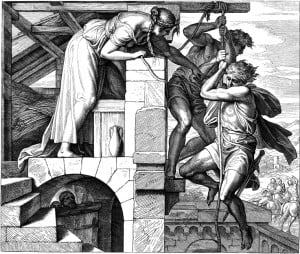 I just had a fascinating interaction online in the context of discussing the relation of the One-time Testament to the New. The conversation went something like this.
Blogger: 'There is no difference between the OT and the NT. There is nothing in the NT which is not in the OT.'
Me: 'What about Jesus?'
Blogger: 'He is all over the One-time Testament. Y'all simply accept to look.'
Me: 'Really? Where for example?'
He and so offered me the following emblematic reading of the Joshua 2 based on the fact that Joshua in Hebrew is the same proper name every bit Jesus in Greek (the Hebrew pregnant of course 'God saves', Matt 1.21):
The conquest of the land is not a prediction of Jesus. It is a prediction of reclaiming Adam's or man's rightful place in the Garden of Eden. Every bit yous know, the Bible starts with Adam or man losing his place in the garden. The Bible then ends with man reclaiming his rightful and original identify in the new globe in the book of Revelation.
Joshua is a type of Christ in the OT. He leads the Israelites to the promised land but as Jesus leads usa to salvation. Joshua destroys the urban center of Jericho not by forcefulness, but with the representation of the Word of God based on the Police force of God through the blowing of the trumpets while walking in front end of the Ark. The family of Rahab is saved by two Israelites who represent the two witnesses or the two books of the Bible. Rahab makes a covenant with them just every bit Jesus makes a covenant with usa through His Word. Ultimately, Rahab is saved by a cerise cord that is draped out of her window. Obviously the blood-red represents the blood of Christ.
When I responded that I was not persuaded that this was in fact the 'meaning' of the text, I was offered further 'insight':
The whole story of the gospel is in the story of Joshua and Rahab. In improver to the tidbits I gave you earlier, I will give you some more than spiritual insight on this story. You will observe that throughout the Bible, the church is represented by a woman. I submit to you that Rahab represents the church in this story. Just similar God's true church on globe, Rahab is the only i in the metropolis of Jericho to make a covenant with the 2 Israelites. In fact, she is told to bring all her family unit into her household if they desire to be saved. Is this not the gospel? Are nosotros as the church, not suppose to bring in every lost soul to be saved? Are nosotros non supposed to spread the gospel? Discover in the story that only those that were with Rahab in her household was saved past hanging the scarlet thread. Now Ian, you should at least hold that the color cherry is no coincidence here when it represents salvation. It is very obvious that it represents the claret of Christ.
I had non come across this reading earlier (do I demand to become out more?) just I have to say I plant it fascinating, and can readily see its appeal. In some ways it appears to come up shut to Paul's own reading of the OT ('the rock was Christ' ane Cor 10.iv, 'Hagar stands for Mt Sinai' Gal 4.25) and in fact Paul uses the give-and-takeallegoreo in introducing this idea. Perhaps the best known emblematic reading is of the parable of the Good Samaritan in Luke 10. Origen read it allegorically thus:
The man who was going downward is Adam. Jerusalem is paradise, and Jericho is the world. The robbers are hostile powers. The priest is the Law, the Levite is the prophets, and the Samaritan is Christ. The wounds are defiance, the beast is the Lord's trunk, the [inn], which accepts all who wish to enter, is the Church. … The manager of the [inn] is the caput of the Church, to whom its care has been entrusted. And the fact that the Samaritan promises he will render represents the Savior's second coming. (Homily 34.3)
This reading was virtually universal throughout early Christianity, being advocated by Irenaeus, Clement also as Origen, and in the quaternary and fifth centuries by Chrysostom in Constantinople, Ambrose in Milan, and Augustine—whose version is perhaps best known:
A certain human went down from Jerusalem to Jericho; Adam himself is meant; Jerusalem is the heavenly city of peace, from whose blessedness Adam roughshod; Jericho ways the moon, and signifies our mortality, considering it is born, waxes, wanes, an dies. Thieves are the devil and his angels. Who stripped him, namely; of his immortality; and beat him, past persuading him to sin; and left him half-dead, because in then far as man can understand and know God, he lives, but in so far as he is wasted and oppressed by sin, he is dead; he is therefore chosen half-expressionless. The priest and the Levite who saw him and passed by, signify the priesthood and ministry of the Old Attestation which could turn a profit nothing for conservancy. Samaritan means Guardian, and therefore the Lord Himself is signified by this name. The binding of the wounds is the restraint of sin. Oil is the comfort of adept hope; wine the exhortation to work with fervent spirit. The beast is the flesh in which He deigned to come to us. The being set upon the creature is conventionalities in the incarnation of Christ. The inn is the Church building, where travelers returning to their heavenly country are refreshed afterwards pilgrimage. The morrow is afterward the resurrection of the Lord. The two pence are either the ii precepts of love, or the hope of this life and of that which is to come.
What is wrong with these readings? After all (equally another blogger comments) does this not 'cohere with and flow from the Church's proclamation of the Cantankerous and Resurrection'? The Reformers had no time for such readings, and Calvin gives this brusk shrift:
The allegory which is here contrived by the advocates of free will is likewise absurd to deserve refutation… I acknowledge that I have no liking for whatsoever of these interpretations; but we ought to accept a deeper reverence for Scripture than to reckon ourselves at liberty to disguise its natural pregnant. And, indeed, any i may see that the curiosity of certain men has led them to contrive these speculations, contrary to the intention of Christ. (Commentary on Matthew, Mark and Luke volume 3)
Of course, the great paradox here is that I suspect the person who offered me the allegory of Joshua comes from a Reformed church that esteems Calvin.
And then what is wrong with this kind of reading?
 Firstly information technology functions by pulling the text into the world of the reader, instead of taking the reader into the globe of the text. In doing this, every bit Calvin states, it 'disguises its natural meaning', or as I would limited it, this approach actually silences the text. We are left not with the text merely with the apologue. The main betoken of Jesus' parable is a call to upstanding activity: 'Go g and do likewise.' The principal point about the Joshua narrative is that God'due south mercy extends to unexpected people (I would argue). Both of these are lost in the allegory.
Secondly and perhaps more surprising, the apologue actually silences itself. It offers such a systematised fashion of reading that information technology precludes any interaction or reflection. Moving over the pocket-sized point that in one part of the allegory Joshua is Jesus but in another part the scarlet cord is, I wonder what the implications might be of seeing the people of God non merely every bit a woman, but equally a racially outcast prostitute? Or that Jesus' decease was like a cord that had been skilfully woven by the hands of such a woman? I think you lot could defend this notion past looking at the key function of (marginalised) women in the gospels, bearers (literally) of God's good news at the get-go of Jesus' life, the only ones who remained by his cantankerous in his death, and the start witnesses of his resurrection. But I really dubiousness that this was in the mind of my give-and-take partner!
Thirdly information technology eliminates issues and challenges in the text. The Book of Joshua is a prime example of the difficulty of reading about divinely sanctioned violence and even genocide. I consider this problem in another post—simply of class the moment you read allegorically, the problem disappears. It is worth noting that the NT never reads Joshua allegorically.
Fourthly this approach ignores a basic feature of the text—its genre. Information technology presents itself as cypher other than a (theologically shaped) historical business relationship of things that happened. If nosotros can read this allegorically or figuratively, then why not exercise the same to the stories nearly Jesus? The resurrection was non something that happened, but a mode of describing the apostles' feeling that somehow Jesus had a new significance beyond expiry.
Fifthly it turns the commentator into a priest—someone who stands between me and the text and mediates the meaning to me. I had not worked out that the thread was the blood of Jesus—how could I? When I was slow to go with the apologue of Joshua, I was enjoined:
The OT is total of stories like this where the gospel and the conservancy of Jesus is represented. You but have to open your heart and look through your "spiritual glasses"! Praise God for the wonderful true stories!! I beg of you to pray and enquire God to open your heart and mind. The OT is not just a historical record. Every story has deep inspirational and spiritual meaning for u.s.a..
Of course, what he really meant was not that the OT is more than a historical record—information technology is inappreciably historical at all. And it is not that I have to look through my 'spiritual glasses' but that I had to wait throughhis glasses!
In the end, the allegorical approach de-historicizes the text and undermines the idea that texts are bearers of meaning. Instead, they get a sort of code that needs unlocking with a secret key which only belongs to the initiated—which is gnostic rather than rational. Annotation that this is a very dissimilar exercise from reading a text metaphorically, or finding application by seeing parallels in the text with later texts or our ain situation.
So generally speaking if you are finding a biblical passage strange, baffling and difficult to sympathize, this is a skilful affair. On the other paw, if y'all read and think it all makes sense, fits perfectly with your theology and there is no challenge here—that's the time to showtime worrying!
If yous enjoyed this, do share it on social media (Facebook or Twitter) using the buttons on the left. Follow me on Twitter @psephizo. Like my page on Facebook.
Much of my work is washed on a freelance basis. If you have valued this mail, you can brand a single or repeat donation through PayPal:
Comments policy: Skillful comments that appoint with the content of the mail, and share in respectful fence, can add real value. Seek first to sympathise, then to be understood. Make the nigh charitable construal of the views of others and seek to learn from their perspectives. Don't view debate as a conflict to win; address the argument rather than tackling the person.
Source: https://www.psephizo.com/biblical-studies/what-is-wrong-with-allegorical-reading/
0 Response to "What is wrong with allegorical reading?"
Post a Comment