Can I Be a Sugar Baby and Have a Job?
Is sugar actually bad for you?

People who swallow more than sweets are at higher hazard of type 2 diabetes, eye disease and cancer… but that may not actually exist saccharide's fault. BBC Future investigates the latest findings.
G
Given the current state of affairs, many of us are more interested than ever in how food tin can (and tin't) support our health. To help you sort out fact from fiction, BBC Future is bringing back some of our nigh popular nutrition stories.
Our colleagues at BBC Good Nutrient are also focusing on practical solutions for ingredient swaps, nutritious storecupboard recipes and all aspects of cooking and eating during lockdown.
It'southward difficult to imagine now, but there was a time when humans only had access to sugar for a few months a yr when fruit was in season. Some 80,000 years agone, hunter-gatherers ate fruit sporadically and infrequently, since they were competing with birds.
At present, our sugar hits come all year circular, ofttimes with less nutritional value and far more easily – by simply opening a soft drink or cereal box. It doesn't take an skillful to see that our mod sugar intake is less healthy than it was in our foraging days. Today, sugar has become public health enemy number one: governments are taxing information technology, schools and hospitals are removing it from vending machines and experts are advising that we remove it completely from our diets. It has even been blamed for peradventure increasing the adventure of contracting infections considering it allegedly suppresses the immune arrangement, although in reality the bear on it has on our ability to fight off diseases is a not bad deal more complicated than that.
And then far, scientists have had a difficult time proving how it affects our health, independent of a diet as well loftier in calories. A review of enquiry conducted over the last 5 years summarised that a diet of more than 150g of fructose per 24-hour interval reduces insulin sensitivity – and therefore increases the risk of developing wellness issues similar high blood pressure and cholesterol levels. But the researchers as well ended that this occurs most ofttimes when high sugar intake is combined with excess calories, and that the effects on wellness are "more probable" due to carbohydrate intake increasing the hazard of excess calories, not the impact of sugar alone.
Meanwhile, there is also a growing statement that demonising a single food is dangerous – and causes confusion that risks us cutting out vital foods.
Sugar, otherwise known as "added sugar", includes table sugar, sweeteners, honey and fruit juices, and is extracted, refined and added to food and drink to improve gustatory modality.

The term 'sugar' includes a wide array of sweeteners, including the fructose naturally constitute in fruit (Credit: Getty)
But both complex and simple carbohydrates are fabricated upwards of sugar molecules, which are broken downward past digestion into glucose and used past every cell in the trunk to generate energy and fuel the brain. Complex carbohydrates include wholegrains and vegetables. Simple carbohydrates are more than easily digested and quickly release sugar into the bloodstream. They include sugars establish naturally in the foods we consume, such every bit fructose, lactose, sucrose and glucose and others, similar high fructose corn syrup, which are manmade.
You might besides like:
• Are bogus sweeteners really bad for us?
• We don't demand nigh as much protein every bit we consume
• The world'due south most nutritious foods
Before the 16th Century only the rich could afford sugar. Only information technology became more available with colonial trade.
So, in the 1960s, the development of large-calibration conversion of glucose into fructose led to the creation of loftier fructose corn syrup, a concentrate of glucose and fructose.
This potent combination, above any other single blazon of carbohydrate, is the one many public wellness advocates consider the near lethal – and it is the ane that many people call up of when they call back of "carbohydrate".
Sugar blitz
Consumption of high fructose corn syrup in the United states of america increased tenfold between 1970 and 1990, more than any other nutrient group. Researchers have pointed out that this mirrors the increase in obesity across the country.

Some researchers believe that once loftier fructose corn syrup became so mutual, an obesity crisis was simply a matter of time (Credit: Getty)
Meanwhile, sugary drinks, which commonly utilize high fructose corn syrup, have been central to research examining the furnishings of sugar on our health. One meta-analysis of 88 studies constitute a link between sugary drinks consumption and body weight. In other words, people don't fully recoup for getting energy from soft drinks by consuming less of other foods – possibly because these drinks increase hunger or decrease satiety.
But the researchers concluded that while the intake of soft drinks and added sugars has increased alongside obesity in the US, the data simply represents wide correlations.
And not everyone agrees that high fructose corn syrup is the driving factor in the obesity crisis. Some experts point out that consumption of the sugar has been failing for the past x years in countries including the Usa, even while obesity levels have been rising. There besides are epidemics of obesity and diabetes in areas where at that place is little or no high fructose corn syrup available, such as Commonwealth of australia and Europe.
High fructose corn syrup isn't the merely kind of sugar seen as problematic. Added carbohydrate, particularly fructose, is blamed for a variety of problems.
For 1, it'south said to cause centre disease. When liver cells interruption downwardly fructose, one of the end products is triglyceride – a grade of fat – which can build up in liver cells over time. When it is released into the bloodstream, it can contribute to the growth of fat-filled plaque inside artery walls.
Fructose, which naturally occurs in fruit and is a key component of high-fructose corn syrup, can contribute to the growth of plaque in arteries (Credit: Getty)
I 15-year study seemed to dorsum this up: information technology plant that people who consumed 25% or more of their daily calories as added saccharide were more than than twice as likely to dice from heart disease than those who consumed less than 10%. Type ii diabetes likewise is attributed to added saccharide intake. 2 big studies in the 1990s found that women who consumed more than ane soft potable or fruit juice per 24-hour interval were twice as likely to develop diabetes as those who rarely did so.
Sweet nothings?
Just again, it's unclear if that means sugar really causes heart affliction or diabetes. Luc Tappy, professor of physiology at the Academy of Lausanne, is 1 of many scientists who argue that the master cause of diabetes, obesity and high blood pressure level is excess calorie intake, and that carbohydrate is merely one component of this.

Many scientists believe that sugar solitary doesn't cause obesity – only that, instead, sugar often is function of a diet with too high of a calorie intake in general (Credit: Getty)
"More energy intake than energy expenditure will, in the long term, pb to fat deposition, insulin resistance and a fat liver, whatever the diet limerick," he says. "In people with a high energy output and a matched energy intake, even a loftier fructose/saccharide diet will be well tolerated."
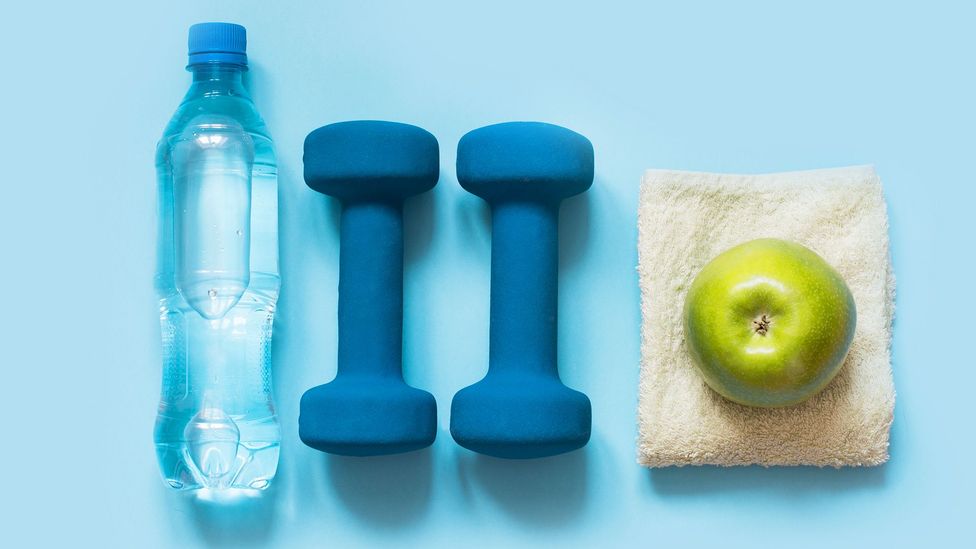
Athletes often eat more sugar than other people, but considering they metabolise it during exercise, they still accept lower rates of cardiovascular disease (Credit: Getty)
Overall, testify that added sugar directly causes type 2 diabetes, middle disease, obesity or cancer is sparse. Yes, higher intakes are associated with these conditions. But clinical trials have yet to establish that it causes them.
Sugar too has been associated with addiction… but this finding, besides, may not be what it seems. A review published in the British Journal of Sports Medicine in 2022 cited findings that mice can experience carbohydrate withdrawal and argued that sugar produces similar effects to cocaine, such every bit craving. Just the paper was widely accused of misinterpreting the evidence. I key criticism was that the animals were restricted to having carbohydrate for two hours a twenty-four hour period: if you let them to take it whenever they want information technology, which reflects how we consume it, they don't show addiction-like behaviours.
Still, studies take demonstrated other ways in which sugar affects our brains. Matthew Pase, research fellow at Swinburne'due south Center for Man Psychopharmacology in Commonwealth of australia, examined the association between cocky-reported sugary drink consumption and markers of brain wellness adamant by MRI scans. Those who drank soft drinks and fruit juices more frequently displayed smaller average brain volumes and poorer memory function. Consuming two sugary drinks per day anile the brain 2 years compared to those who didn't drink whatsoever at all. Just Pase explains that since he only measured fruit juice intake, he tin't be certain that sugar lone is what affects brain health.

One study found that consuming ii juice drinks per day aged the brain past 2 years, compared to non drinking any (Credit: Getty)
"People who drink more fruit juice or soft drinks may share other dietary or lifestyle habits that relate to brain health. For example, they may also practice less," Pase says.
1 recent study institute that sugar may fifty-fifty help better retentivity and performance in older adults. Researchers gave participants a drink containing a small amount of glucose and asked them to perform various memory tasks. Other participants were given a drink containing artificial sweetener as a control. They measured the participants' levels of date, their retention score, and their own perception of how much endeavour they'd applied.
The results suggested that consuming saccharide tin can make older people more motivated to perform difficult tasks at full chapters – without them feeling as if they tried harder. Increased blood sugar levels also fabricated them feel happier during the chore.

In older adults, consuming a sugary drink may make them more motivated and even happier during a job (Credit: Getty)
Younger adults showed increased free energy afterwards consuming the glucose drinkable, only it didn't affect their mood or retentivity.
Teaspoon of saccharide
While electric current guidelines propose that added sugars shouldn't make upwardly more than than v% of our daily calorie intake, dietitian Renee McGregor says it'southward important to understand that a healthy, balanced diet is different for everyone.
"I work with athletes who need to take on more sugar when doing a hard session because it's easily digestible. Just they worry they're going over the guidelines," she says.
For most of u.s.a. not-athletes, it's true that added sugar isn't crucial for a salubrious diet. But some experts warn we shouldn't single information technology out as toxic.
McGregor, whose clients include those with orthorexia, a fixation with eating healthily, says that it isn't salubrious to label foods as "good" or "bad". And turning sugar into a taboo may merely make information technology more tempting. "As presently as you say yous can't have something, you lot want it," she says. "That'southward why I never say annihilation is off-limits. I'll say a nutrient has no nutritional value. But sometimes foods have other values."

Fifty-fifty when sweet foods have picayune or no nutritional value, they take other values (Credit: Getty)
Acquaintance professor at James Madison Academy Alan Levinovitz studies the relationship between religion and science. He says there's a simple reason nosotros await at saccharide every bit evil: throughout history, we've demonised the things we find hardest to resist (recall of sexual pleasure in the Victorian times).
Today, we do this with sugar to gain control over cravings.
"Sugar is intensely pleasurable, then we accept to run across it as a cardinal sin. When we come across things in simple good and evil binaries, it becomes unthinkable that this evil affair can exist in moderation. This is happening with saccharide," he says.
He argues that that seeing food in such extremes can make us anxious virtually what we're eating – and add a moral judgment onto something as necessary, and as everyday, as deciding what to consume.

We demonise the things we find hard to resist – including sugar (Credit: Getty)
Taking carbohydrate out of our diets can fifty-fifty exist counterproductive: it can mean replacing it with something potentially more than calorific, such as if you substitute a fat for a sugar in a recipe.
And amid the ascension debate around carbohydrate, we risk confusing those foods and drinks with added sugar that lack other essential nutrients, like soft drinks, with healthy foods that have sugars, similar fruit.
One person who struggled with this distinction is 28-yr-sometime Tina Grundin of Sweden, who says she used to think all sugars were unhealthy. She pursued a high-protein, high-fat vegan nutrition, which she says led to an undiagnosed eating disorder.
"When I started throwing up subsequently eating, I knew I couldn't keep much longer. I'd grown upwardly fearing sugar in all forms," she says. "So I realised there was a difference between added carbohydrate and sugar as a carbohydrate and I adopted a high-fructose, loftier-starch nutrition with natural sugars found in fruit, vegetables, starches and legumes.
"From the showtime day, information technology was like the fog lifted and I could come across clearly. I finally gave my cells fuel, found in glucose, from carbohydrates, from sugars."
While there'south disagreement around how different types of sugars affect our wellness, the irony is we might be better off thinking about it less.
"Nosotros've really overcomplicated diet because, fundamentally, what anybody is searching for is a demand to feel complete, to feel perfect and successful," says McGregor. "But that doesn't be."
Correction: An earlier version of this story referred to glucose and sucrose as being manmade. This has been changed. An before version of the story besides said that high fructose corn syrup doesn't atomic number 82 to a rise in leptin; however, as about related inquiry has been done on fructose, not high fructose corn syrup, this has been changed. Carbohydrate's effect on insulin and its relation also has been antiseptic.
Join 900,000+ Future fans by liking usa on Facebook, or follow us on Twitter or Instagram.
If you lot liked this story, sign upwards for the weekly bbc.com features newsletter, called "If Y'all Only Read half dozen Things This Calendar week". A handpicked choice of stories from BBC Future, Culture, Capital, and Travel, delivered to your inbox every Fri.
Source: https://www.bbc.com/future/article/20180918-is-sugar-really-bad-for-you
0 Response to "Can I Be a Sugar Baby and Have a Job?"
Post a Comment